Friday, February 24, 2012
Transmedia Digest is Moving
Please Note: This blog is moving to a new blogging platform. Please go to www.transmediadigest.com and bookmark it so you have access to the additional features and content we are adding.


Ontology: Characters (Part 3)
Campbell identified the three stages of the journey as departure, initiation, and return. Within those three stages, Campbell identified a series of steps (Campbell, 1949, pp. ix-x):
Please Note: This blog is moving to a new blogging platform. Please go to www.transmediadigest.com and bookmark it so you have access to the additional features and content we are adding.
- Departure: The departureis the first of the three stages of the hero’s journey and consists of five steps:
- Call to Adventure: The call to adventure occurs at the point in a person’s life when something important happens, sending the person in a new direction.
- Refusal of the Call: Sometimes when a person receives a call to adventure, a refusal of the call occurs because of fear, a feeling that he/she can’t leave certain responsibilities, or concerns about not being strong enough or smart enough to start an adventure.
- Supernatural Aid: Once the hero has started the adventure, supernatural aid in the form of a guardian, guide or mystical/magical helper appears to provide help. This character may or may not be human.
- Crossing of the First Threshold: When the hero leaves familiar surroundings and normal life behind, this is the crossing of the first threshold. It marks the point at which the hero enters into the unknown to truly begin the adventure in dangerous places where the rules are no longer known.
- Belly of the Whale: The hero is truly between worlds upon entering the belly of the whale. At this point in the adventure, the familiar world has been left behind and the world ahead is unknown, often leaving the hero frightened, feeling alone, and beginning to recognize the magnitude of the task that he/she has undertaken and the challenges that are to come.
- Initiation: The initiationis the second stage of the hero’s journey and consists of six steps:
- Road of Trials: The road of trials is a series of tests, tasks, or ordeals that a person must undergo as part of becoming a hero.
- Meeting with the Goddess: After surviving the road of trials, the hero experiences a meeting with the goddess, which takes the form of experiencing a great love – perhaps romantic love, or a love for friends and family, or the experience of a divine love – from which the hero gains strength and a sense of well being.
- Temptation: At some point in the adventure, the hero experiences the temptation to quit the journey and go home.
- Atonement: The atonement is the center point of the journey. All the previous steps have been moving in to this place, all that follow will move out from it. At this point in the journey, the hero must face whatever holds the ultimate power in his or her life.
- Apotheosis: After facing and surviving the great power in his/her life, the hero may experience the oneness and beauty of the universe. The apotheosis is a period of rest and reflection before the return journey is made.
- Ultimate Boon: The ultimate boon occurs when the hero has achieved the primary goal of the journey.
- Return: The returnis the third and final stage of the hero’s journey and consists of six steps.
- Refusal of the Return: The refusal of the return occurs if the hero refuses to go back to a normal life. This can occur if the adventure has been a glorious one or if the hero is concerned that his/her message will not be heard.
- Magic Flight: The magic flight occurs if the hero must steal the boon and make a daring escape that is as adventurous and dangerous as the first part of the journey was.
- Rescue from Without: The rescue from without occurs when the hero needs the help of a guardian or guide to return to a normal life.
- Crossing of the Return Threshold: At the crossing of the return threshold the hero returns to the normal and familiar, and the challenge is now to remember what was learned on the journey and use it to improve his/her life and the lives of others in the normal world.
- Master of the Two Worlds: The hero has learned to be comfortable in both the everyday world and the world of adventure, including being comfortable with who he/she is and with others. The hero may also be ready to take on the role of guardian or guide for someone else. This makes him or her master of the two worlds.
- Freedom to Live: In the last step of the journey, the hero has mastered the fears of life and has achieved the freedom to live without those fears.
 |
| Concept map of elements of hero's journey |
Please Note: This blog is moving to a new blogging platform. Please go to www.transmediadigest.com and bookmark it so you have access to the additional features and content we are adding.
Wednesday, February 22, 2012
Ontology: Characters (Part 2)
Different characters play different roles in a story. These roles
fall into three categories (Card, 1988, p. 59), with the major
characters identified in more specific roles:
A number of lists of archetypal character have been compiled. Schmidt’s compilation of 45 archetypal characters is one such list (Schmidt, 2001):
- Major characters: The major charactersdrive
the plot through its twists and turns and move the story forward. The
major characters fill a variety roles (Phillips & Huntley, 1996, pp.
36-38):
- Protagonist: The protagonist is the main character role in a story and drives the action. The protagonist will have a goal and undergoes a change – the “hero’s journey” – in the process of seeking to achieve that goal.
- Antagonist: The character in the role of antagonist is in direct opposition to the protagonist. The antagonist may seek the same goal (e.g. find the significant object of the story) as the protagonist or may simply want to prevent the protagonist from achieving that goal.
- Sidekick: The sidekick character role may be linked to the protagonist or antagonist. Each of those character roles may have its own sidekick. The sidekick character provides loyalty and support throughout the story and has unfailing faith in the rightness of the goals and actions of the protagonist or antagonist to which he/she is linked.
- Guardian: The guardian character role is that of mentor or teacher to the protagonist. The guardian provides knowledge, guidance, support, and protection but also drives the protagonist towards achieving the protagonist’s goal.
- Skeptic: The skeptic character role is linked to the protagonist, but this character’s role is to question and doubt everything – the protagonist’s thoughts, emotions and actions, the trustworthiness of other characters, anything and everything.
- Emotion: The emotion character role is linked to the protagonist and responds to story events emotionally without thinking and without concern for the practical implications of a response.
- Reason: The reason character role is linked to the protagonist and responds to events in the narrative logically, while not letting emotion interfere with the rational.
- Temptation: The temptation character role is not necessarily directly opposed to the protagonist, but rather tries to hinder, divert, and delude the protagonist from achieving his/her goal, often by tempting and playing on the weaknesses of the protagonist.
- Minor characters: The minor characters have a limited impact on the story, with their desires and actions causing plot twists but not substantially shaping the overall flow of the story. Typically, minor characters do one or two things before disappearing from the story.
- Walk-on and placeholder characters: The walk-on and placeholder characters exist in the background to add realism or, if they appear in the foreground, it is to serve a simple function and then disappear.
 |
| Concept map of character roles and archetypes |
A number of lists of archetypal character have been compiled. Schmidt’s compilation of 45 archetypal characters is one such list (Schmidt, 2001):
- Male Hero/Villain Types
- Businessman/Traitor
- Protector/Gladiator
- Recluse/Warlock
- Fool/Derelict
- Woman’s Man/Seducer
- Male Messiah/Punisher
- Artist/Abuser
- King/Dictator
- Female Hero/Villain Types
- Seductive Muse/Femme Fatale
- Amazon/Gorgon
- Father’s Daughter/Backstabber
- Nurturer/Over Controlling Mother
- Matriarch/Scorned Woman
- Female Messiah/Destroyer
- Maiden/Troubled Teen
- Supporting Types
- Friends of Protagonist
- Magi
- Mentor
- Best Friend
- Lover
- Rivals of Protagonist
- Joker
- Jester
- Nemesis
- Investigator
- Pessimist
- Psychic
- Symbols
- Shadow
- Lost Soul
- Double
- Friends of Protagonist
Monday, February 20, 2012
Ontology: Characters (Part 1)
The second category of existent is the characters (human or otherwise), which are sentient beings with the ability to feel, perceive, or to have subjective experiences. Characters have a number of properties that help define them. These include:
- Physical characteristics: The physical characteristics are what the character looks like. The physical characteristics are a starting point for developing characters, but don’t fully describe a character.
- Psychological characteristics: The character’s feelings, beliefs, self-image, self-doubts, hunches, intuitions, and “millions of other mysterious and often ill-defined and contradictory forces that work within him” compose the psychological characteristics of the character. They make up the internal life that the character leads (Glassner, 2004).
- Behavioral characteristics: The character’s behavioral characteristics are the visible behavior. When contrasted with the character’s psychological characteristics, they can tell a lot about that character and make the story much richer.
- Social characteristics: The character’s social characteristics determine the interpersonal and social interactions (e.g. how he/she relates to other characters individually and in general).
- Motivations: The character’s motivations are driven by the needs identified in Maslow’s Hierarchy (Maslow, Frager, & Fadiman, 1987):
- Physiological needs – the most basic needs for human survival, without which the human body cannot function (e.g. air, water, food, sleep, sex, etc.).
- Safety needs – include personal security from physical threats, health and well-being, and financial security (e.g. security of body, employment, family, property, resources, etc.).
- Love and belonging needs – love, acceptance, and belonging with family, intimate partners, friends, and larger social groups (e.g. family, sexual and non-sexual intimacy, friends, etc.)
- Esteem needs –lower level esteem needs are met by having the respect of others, status, recognition, fame, prestige, and attention. The higher level esteem needs are the need for self-respect, strength, competence, mastery, self-confidence, independence and freedom.
- Self-actualization needs – pertain to achieving one’s full potential and the desire to become everything that one is capable of becoming (e.g. morality, creativity, spontaneity, acceptance of facts, lack of prejudice, etc.)
- Self-transcendence – going beyond a prior form or state of oneself (e.g. making spiritual connections) (Frankl, 2006, p. 111).
- Values: A character’s values are the important ideas, beliefs or understandings that character holds and uses as a guide for his or her behavior (Scerenko, 1997). These values may change as the character progresses through the story. (See Appendix G for a list of values that can be applied to characters.)
- Desires: The character’s desires are what the character cares about or wants. These desires can drive the character to certain actions, including abandoning the character’s own values. Desires may be conscious or unconscious and could conflict, resulting in a more complex character. Throughout the course of the story the character will take action to fulfill those desires.
- Fears: The character’s fears are those things he or she is most afraid of. How the character deals with those fears can impact specific plot points by putting in doubt the character’s response to specific situations. Fears can be linked to Maslow’s hierarchy of needs.
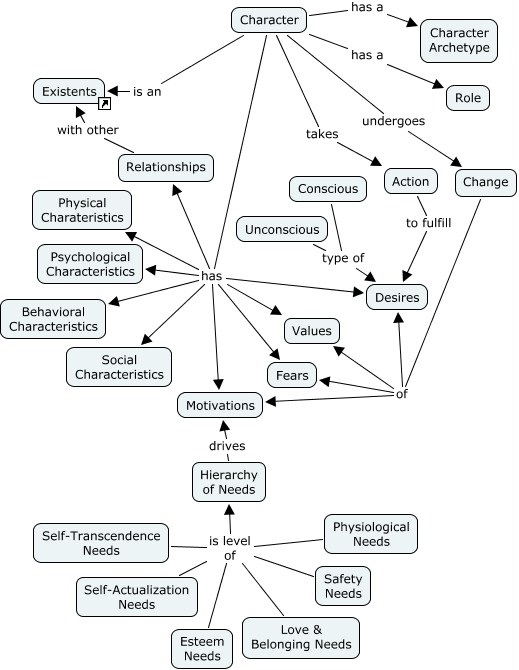 |
| Concept map of character properties |
Friday, February 17, 2012
Story Level Design Tasks
Over the past few weeks we have been looking at the first (transmedia project) and second (storyworld) level design tasks. Once work at these levels is substantially complete, it is time to move on to the next level of tasks.
The third level of design tasks occurs at the story level (see table below). At this level key decisions on individual stories within the storyworld are made. The narrative design tasks begin with the development of the story concept, dramatic question, and controlling idea, which will shape the narrative content. That is followed by the selection of story structure, narrative point of view, plot structure, and identification of any sub-stories. The decisions made when doing these tasks will determine how the content will be structured from a narrative perspective.
Significant objects and the cast of characters that will populate the story are also created at this level. The interaction design tasks focus on identification of media and platforms that may be used to publish the story, develop a preliminary overview of user navigation, and preliminary identification of story assets.
| Story Level Design Tasks | ||
| Narrative Design | Engagement Design | Interaction Design |
|
|
|
Wednesday, February 15, 2012
Ontology: Significant Objects
Significant objects are one type of existent. There are two types of significant objects:
The properties of a significant object are:
- Plot-Signficant: A plot-significant object has a substantial impact on the story’s plot.
- Character-Significant: A character-significant object has some sort of significance to a particular character but does not have a significant impact on the story’s plot.
The properties of a significant object are:
- Physical Characteristics: The physical characteristics of the significant object describe its size, weight, appearance, and other physical aspects.
- Value: The significant object has valueto the characters in the story. This value may be:
- Intrinsic – it is worth money (e.g. a treasure, money, etc.)
- Source of power – it gives the person who possesses it magical, political, or some other form of power
- Symbolic – it has spiritual, emotional, sentimental, or similar symbolic value
- Integral to the Plot: The significant object is integral to the plot; without it the story would change significantly.
 |
| Concept map of elements of significant objects |
Monday, February 13, 2012
Ontology: Storyworlds
Ryan’s description of the contents of storyworlds (Ryan, 2011)
provides a starting point for the development of a systematic structure
for the narrative elements of transmedia narratives. Ryan identified the
content of storyworlds as existents, settings, events, mental events,
physical laws, and social laws (Ryan, 2011).
Chatman proposed a story structure that also contains events and existents (Chatman, 1978, p. 19), but their interrelationships differ from Ryan’s. In Chatman’s model, characters and setting are contained within the existents, while events are divided into kernels and satellites (Chatman, 1978, p. 19).
The development of a comprehensive and consistent structure for storyworlds is important for the future development of transmedia narratives. Ryan stated that ensuring stories involve the same existents, settings, and other characteristics of the storyworld and that the stories are mutually compatible will allow the development of multiple stories within the same storyworld (Ryan, 2011).
Using the same set of concepts identified by Ryan and Chapman – storyworlds, existents, events, settings, and stories – but reconfiguring the relationships between them slightly makes it possible to create a high level framework that easily accommodates the creation of multiple stories from within the same storyworld.
A few of the concepts offered by Ryan fall into categories lower down on the storyworld hierarchy, while mental events is a type of event. Physical and social laws fall within the concepts of mythos, topos, and ethos developed by Klastrup and Tosca. Klastrup and Tosca note that they specifically exclude events from the mythos of a storyworld (Klastrup & Tosca, 2011). This makes it logical to include events immediately below the storyworld in the hierarchy of elements, as Ryan has done.
Establishing the storyworld as the highest order category within the narrative design domain provides the foundation for a coherent structure with ample opportunity for expansion across the lower level concepts.
 |
| Concept map of the elements that comprise a storyworld |
- Storyworld: A storyworldis
the structure within which all of the concepts, objects, entities, and
relationships needed to construct a narrative exist. Properties of or
elements contained within the storyworld are:
- Temporal Dimension: A temporal dimension is an inherent property of a storyworld and by extension is part of the existents, events, settings, and stories that are contained within that storyworld. This temporal dimension is called “storyworld time”.
- Genre: The genre for a storyworld defines the stylistic conventions for characters, roles, settings, events, and values that are used in the storyworld.
- Existents: The existents are either significant objects or characters. (Ryan, Storyworlds Across Media, 2011) Further details on these two concepts are developed in the section on the ontology of existents.
- Events: The events in a storyworld are the result of changes in the state of elements within the storyworld. Further details on events are developed in the section on the ontology of events.
- Settings: A storyworld’s settings serve as the backdrop against which a narrative occurs. Further details on settings are developed in the section on the ontology of settings.
- Story: A story emerges from the interrelationship of a storyworld’s existents, events, and settings.
Subscribe to:
Posts (Atom)